A cable designation is a compressed specification, and reading it correctly is the fastest way to avoid buying the wrong product. Two cables that look identical on a drum can differ by insulation material, temperature rating, armour and standard, simply because one is marked NYY and the other N2XY. This guide decodes the lettering systems used across Europe, China and the CIS, explains what NYY, N2XY, YJV, VGV and CYKY each describe, and shows how to translate a tender document written in one system into a purchase order in another. It closes with six practical answers on letter meanings, substitutions and the mistakes that most often reach site.

European designations follow the German VDE tradition, in which each letter describes one layer of the construction from the conductor outwards. The letter N indicates a cable to a harmonised German standard, or a copper conductor in some notations. Y indicates PVC insulation, and a second Y indicates a PVC sheath. The digit 2 marks XLPE insulation, so N2XY is a copper conductor cable with XLPE insulation and PVC sheath, while NYY is the same geometry with PVC insulation. The letter R marks a round wire armour, so N2XRY is an XLPE insulated, PVC sheathed, round wire armoured cable. C indicates a concentric copper conductor, and O indicates a cable without a green-yellow earth core.
Chinese designations use a different logic. YJ stands for cross-linked polyethylene insulation, V for PVC, and the trailing letters describe the sheath and armour: YJV is XLPE insulated with PVC sheath, YJLV is the aluminium conductor version, and YJV22 adds steel tape armour. The Russian and CIS system uses the Cyrillic-derived Latin forms ВВГ and ВБШв, transliterated as VVG and VBSHV, where the letters again follow a conductor-insulation-sheath-armour sequence. The Czech and Slovak system uses CYKY for a copper conductor, PVC insulated, PVC sheathed cable with a concentric conductor, and AYKY for the aluminium version.
| Symbol | Meaning | Example |
|---|---|---|
| N | Standard cable, copper conductor | NYY |
| Y | PVC insulation or sheath | NYY: PVC insulation + PVC sheath |
| 2 | XLPE insulation | N2XY: XLPE + PVC sheath |
| X | XLPE insulation (alternative notation) | N2XY, XHHW |
| R | Round wire armour | N2XRY |
| C | Concentric copper conductor | NYCY, CYKY |
| O | Without green-yellow core | NYY-O |
| YJ / V | XLPE / PVC (Chinese system) | YJV, YJLV |
| VG / V | PVC insulation and sheath (CIS) | VGV |
The practical consequence is that the designation is not decoration. It tells an experienced buyer the insulation material, the sheath, the armour, the presence of an earth core and, by implication, the maximum conductor temperature, which is 70 degrees Celsius for PVC insulation and 90 degrees Celsius for XLPE. Two cables with the same cross section and the same voltage class can therefore have materially different current ratings.
Designation errors rarely cause an immediate failure. They cause a slow mismatch between design assumptions and delivered product, which surfaces during inspection, during commissioning or, worst of all, during a load test a year later.
1. Wrong temperature rating. Substituting NYY for N2XY looks harmless because the geometry is the same, but the PVC insulation is rated at 70 degrees Celsius instead of 90. A feeder designed at the XLPE current rating will run above the PVC rating under full load, and the insulation will age prematurely. The reverse substitution, N2XY for NYY, is thermally safe but changes the price, which matters when a tender was priced on the cheaper product.
2. Missing armour. A cable ordered as N2XY instead of N2XRY has no armour. In a duct or a cable tray that may be acceptable; in direct burial it is not, because the cable has lost its protection against stones, rodents and future excavation. Designation letters are the only reliable way to confirm armour from a drum label.
3. Earth core confusion. The suffix O means the cable has no green-yellow earth core, so the installer must provide a separate earth conductor. A site that assumes an earth core is present will discover the omission at termination, and the fix may involve re-ordering cable rather than adding a core.
4. Cross system translation. A project specified in YJV but sourced from a European manufacturer will be quoted as N2XY, and a project specified in VGV may be quoted as NYY. These are not always equivalent: the standards behind them differ in sheath thickness, test requirements and core identification. Buyers must confirm equivalence clause by clause rather than accepting a letter substitution.
5. Documentation and warranty. If an inspection finds that the delivered cable designation does not match the approved submittal, the material may be rejected regardless of quality, and the resulting delay is usually more expensive than the cable. Correct designation on the drum label, the test certificate and the delivery note is therefore a commercial requirement, not a formality.
Decode from the conductor outwards and write the result as a sentence. Take N2XRY 4x35 mm2 0.6/1 kV. The N indicates a copper conductor to the German standard, the 2 indicates XLPE insulation, the X is the XLPE marker in this notation, the R indicates round wire armour and the Y indicates a PVC sheath. The result is a copper conductor, XLPE insulated, PVC sheathed, round wire armoured cable rated 0.6/1 kV, suitable for direct burial and rated at 90 degrees Celsius conductor temperature.
Then map the designation to the applicable standard. NYY and N2XY normally reference VDE 0276 or a national derivative, YJV references GB/T 12706, VGV references GOST, and CYKY references the Czech and Slovak national standards. The voltage class, the conductor class per IEC 60228 and the flame test requirement should be stated separately, because the designation alone does not fix them.
Next, decide whether a substitution is technically acceptable and document it. A substitution from PVC to XLPE insulation is thermally an upgrade but changes the current rating and the price. A substitution from copper to aluminium changes the cross section required for the same current and changes the termination method. A substitution from armoured to unarmoured changes the installation rules. Every substitution should be approved in writing, with the affected clauses highlighted, rather than agreed verbally between a buyer and a salesperson.
Finally, control the labelling. The drum label, the test certificate and the packing list should carry the full designation including the voltage class and the cross section, so that a site inspector can compare the delivered item to the approved submittal in one glance. Where a project has multiple designation systems in play, for example a European consultant specifying to a Chinese factory, require a cross reference table in the submittal that maps each project designation to the offered product code.
A short checklist prevents most problems: confirm insulation material and temperature rating, confirm armour type and presence, confirm earth core, confirm standard and voltage class, confirm conductor class, and confirm that the label matches the submittal. Six questions, answered in writing before the order is released, will eliminate the great majority of designation related claims.
| Designation | Insulation | Sheath | Armour | Typical use |
|---|---|---|---|---|
| NYY | PVC | PVC | None | Indoor, duct, buried in protected route |
| N2XY | XLPE | PVC | None | Distribution, higher current |
| N2XRY | XLPE | PVC | Round wire | Direct burial, mechanical protection |
| NYCY | PVC | PVC | Concentric Cu | Earth path and protection |
| YJV | XLPE | PVC | None | Chinese standard distribution |
| VGV | PVC | PVC | None | CIS standard industrial |
| CYKY | PVC | PVC | Concentric | Czech and Slovak distribution |
Examples in current production include the NYY and NYCY fire resistant cable for buildings and house wiring, the NYY 4x25mm2 oxygen free copper cable 0.6/1 kV, and the VGV 3x2.5mm2 rigid oxygen free copper cable 1 kV. Single core distribution uses the N2XY 1x120mm2 single core cable or the NYY-O 1x300mm2 cable without earth core, while multi-core feeders use the N2XY 4x95mm2 multi-core cable for power stations. Underground distribution is served by the CYKY 5x10mm2 underground distribution cable, and where armour is required the N2XRY 4x35mm2 wire armoured cable provides the mechanical protection.
Tender documents rarely arrive in the same designation system as the factory that will make the cable. A consultant in Central Europe may specify N2XY while the enquiry goes to a Chinese manufacturer that quotes YJV, and a CIS utility may specify VGV while the approved supplier works in NYY terminology. The practical translation procedure is to strip the designation down to its five functional attributes: conductor material and class, insulation material and temperature rating, sheath material, armour type and presence, and earth core arrangement. Once those five attributes are written as a plain sentence, the equivalent product can be identified in any system and checked against the applicable standard without ambiguity. What must never be done is to translate letter for letter, because the standards behind the letters differ in sheath thickness, test voltage, core colour sequence and flame performance, and those differences become visible only when an inspector asks for the type test report.
Most designation problems begin in the quotation, not on the production line. A trader offers a cable described as N2XY because that is the closest familiar code, while the actual production is a YJV, and the difference in sheath thickness or core identification is not considered. The drum then arrives with a label that reflects the customer request rather than the delivered construction, and the mismatch is discovered only when the site inspector compares the label with the approved submittal. Three habits prevent this. First, require the offered product code and the standard reference in the quotation, not only the customer designation. Second, require the drum label to show both the project designation and the factory product code. Third, require a sample of the label artwork for approval before production, exactly as with printed packaging. These habits cost nothing and they close the gap where most claims originate.
Finally, keep the decoded specification in the project file next to the approved submittal. When a future extension or a spare drum is ordered two years later, the decoded sentence rather than the bare code is what prevents a silent substitution. A two line table with the project designation, the factory code, the standard and the current rating is enough, and it turns a design decision into an auditable record that survives staff changes on both sides of the transaction.
The first Y denotes PVC insulation and the second Y denotes a PVC sheath. In N2XY the digit 2 replaces the first Y to indicate XLPE insulation instead of PVC.
Functionally both are XLPE insulated PVC sheathed cables, but they follow different standards (VDE and GB/T 12706) with different test and thickness requirements. Equivalence must be confirmed clause by clause.
It indicates a cable without a green-yellow earth core, so a separate protective earth conductor must be installed.
The letter R denotes round wire armour and the suffix 22 in the Chinese system denotes steel tape armour. The absence of these markers means the cable is unarmoured.
Electrically it is usually an upgrade because of the higher temperature rating, but the current rating, price and standard change. Obtain written approval before substituting.
CYKY is a Czech and Slovak designation for a PVC insulated, PVC sheathed cable with a concentric conductor, widely used for underground distribution and service connections.
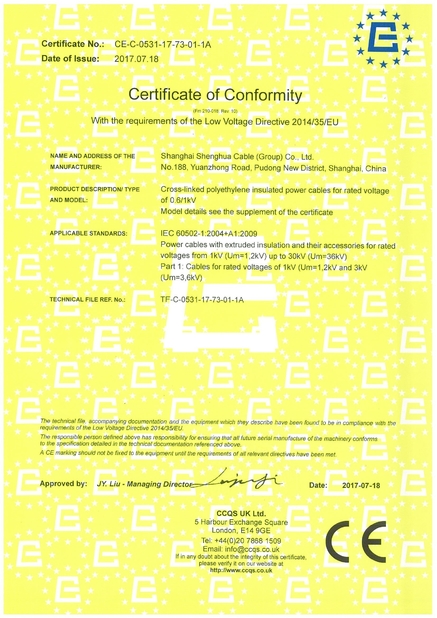
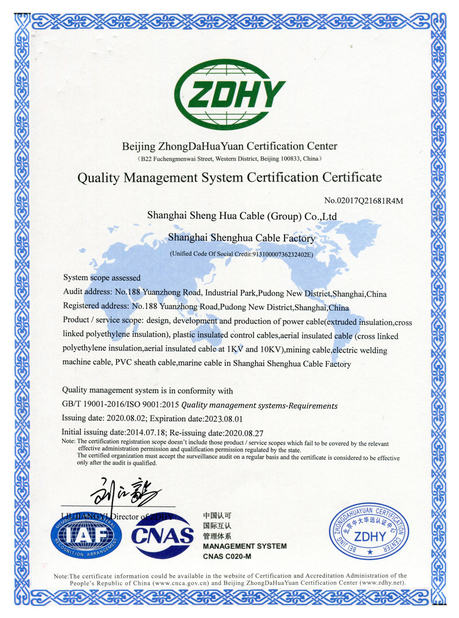
Reading a cable designation is a five minute skill that prevents months of delay. Decode the letters from conductor to sheath, map the code to the standard it belongs to, and confirm insulation temperature rating, armour, earth core and conductor class in writing. Never accept a letter substitution without a documented technical comparison, and insist that the drum label matches the approved submittal. Shanghai Shenghua Cable Group manufactures NYY, N2XY, N2XRY, NYCY, CYKY, YJV and VGV constructions from 0.6/1 kV distribution cable to medium voltage designs, with full designation marking, test certificates and a cross reference table on request. Send your tender designations through our contact page and our engineers will return the exact equivalent, the standard reference and the current rating for each item.