Fire resistant and flame retardant are not the same claim, and confusing them has cost lives. A flame retardant cable resists the spread of fire along a tray; a fire resistant cable continues to carry current while it is being burnt, which is what an emergency lighting circuit, a fire alarm or a smoke extract fan requires. The distinction is defined by test standards such as IEC 60331 and BS 6387, and it is verified by tests that burn the cable while it is energised. This guide explains the difference, how the tests work, where each type is required and how to specify it without ambiguity. Six answers follow on standards, duration, mica tapes and approval.

Flame retardant describes a compound that resists ignition and limits the spread of flame along the cable. The test is a bunsen burner or a tray test: the cable is exposed to a flame for a defined period, and the extent of burning is measured after the flame is removed. PVC compounds are inherently flame retardant because of their chlorine content, which is one reason they remain common in building installations.
Fire resistant describes a cable that continues to function during and after a fire for a defined period. The test is fundamentally different: the cable is energised, exposed to a flame at a specified temperature, and monitored for continuity. A cable that stops carrying current during the test fails, even if it never propagated flame.
The practical consequence is that a flame retardant cable will keep the fire from spreading along a tray but will stop working almost immediately where it is burnt. Emergency systems need the opposite behaviour: they need the circuit to keep working long enough for people to leave the building.
Some cables are both. A fire resistant construction with a flame retardant sheath and low smoke behaviour is the typical specification for emergency circuits in public buildings, tunnels and industrial plants, and it costs considerably more than a standard cable.
IEC 60331 defines fire resistance tests in which the cable is exposed to a flame, usually at around 750 to 950 degrees Celsius, while energised, and must maintain continuity for a defined period, commonly 90 minutes, sometimes 120 or 180.
BS 6387 uses a different structure and adds categories. Category C is resistance to fire alone, category W adds resistance to fire with water spray, and category Z adds resistance to fire with mechanical shock. A cable rated CWZ has passed all three, which is the level often required for circuits that must operate during firefighting and structural movement.
The other relevant tests concern smoke and acidity. Smoke density is measured in a chamber, and acidity is measured by burning a sample and analysing the combustion gases. Low smoke zero halogen constructions are specified where the smoke and the acid gases are the primary hazard, as in tunnels and enclosed public spaces.
These tests are expensive and are performed on samples rather than on every length. A fire resistant claim should therefore always be supported by a test report from an accredited laboratory, with the standard, the category and the duration stated, and the report should cover the construction and size range being supplied.
Fire resistant cable is required for circuits that must operate during a fire: emergency lighting, fire alarm and detection, smoke control and pressurisation fans, sprinkler pumps, evacuation lifts, and communication systems used by the fire service. In many jurisdictions the requirement is written into building codes and is not negotiable.
Flame retardant cable is required more broadly, for general installations in public buildings, tunnels and industrial plants, to limit fire spread. The requirement is usually expressed as a test category rather than as a material, and the buyer should check which category the specification requires.
Low smoke zero halogen cable is required where the smoke and the acid gases are the dominant risk, often in the same locations as fire resistant cable. A tunnel specification may require both properties in the same product, which is why the compound and the construction are developed together.
Standard PVC cable remains appropriate in many locations, particularly where the fire risk is low and the code permits it. The mistake is to use it where the code requires fire resistance, and then to assume that the installation is compliant because the cable is flame retardant.
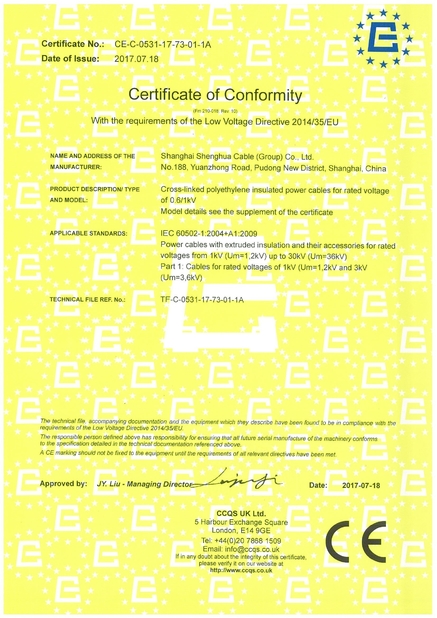
Products such as the 1-5 Cores XLPE Insulated Power Cable With Cable Size 1.5-630mm2 And PVC / LSZH Jacket and the Shanghai Shenghua Power Cable Professional Control Flexible Wire Cable Eco Friendly CE KEMA Certification are typical of circuits where the specification requires verified performance rather than a general claim, and the test report is the deciding document.
State the standard, the category and the duration. Fire resistant to IEC 60331 at 750 degrees for 90 minutes, or BS 6387 category CWZ, is a specification. Fire resistant, on its own, is a claim that cannot be evaluated.
State the smoke and acidity requirements where they apply, using the relevant test and limit. Low smoke zero halogen should be tied to a smoke density test and an acidity test, not used as a description.
Ask for the test report and check three things: the laboratory's accreditation, the construction tested and the size range covered. A report for a single small size does not qualify the whole range, and this is a common gap in supplier documentation.
Specify the accessories. A fire resistant cable terminated in a standard joint loses its performance at the joint, and the standards recognise this by testing complete systems in some cases. Where the circuit is critical, use accessories approved for the same fire performance.
Verify on delivery by checking the marking and the certificate, and keep a retained sample. The marking usually identifies the standard and category, and it is the first thing an inspector looks for on site.
The essential element is a barrier that survives the fire. Mica tape wrapped around the conductor forms a ceramic layer when the binder burns away, and that layer keeps the conductor insulated from the surrounding metal even as the polymer disappears. The number of tape layers and the overlap determine the performance, which is why a cheap construction may pass a short test and fail a longer one.
The insulation and sheath are chosen to limit fire propagation and, where required, to reduce smoke and acid gas. In a low smoke zero halogen design, the compound is halogen free and heavily filled with materials that release water when heated, which cools the flame and dilutes the gases. Those fillers make the compound harder to process, which is one reason the cable costs more.
The earth conductor and the screen, where present, must also survive. A fire resistant cable that loses its earth path during a fire has failed the purpose, because the circuit it protects may depend on that path for its protective device to operate.
A cable that passes a fire resistance test in a laboratory does not necessarily perform in an installation, because the joints, the terminations and the supports also affect the outcome. Some standards address this by testing complete systems, and some projects require system level evidence rather than component evidence.
The practical consequence is that the accessories must be fire rated to the same level as the cable, and the installation method must follow the tested arrangement. A fire resistant cable supported by plastic clips that melt at 100 degrees will fall down before the test period ends, and the circuit is lost regardless of the cable's performance.
For the buyer, the useful question is not only what the cable is rated for but what the tested system comprises. A supplier who can describe the tested arrangement, including the joints and the supports, is offering something that can actually be installed to achieve the rating.
Building codes, fire engineering assessments and insurer requirements all drive the specification. In a high rise building, the fire strategy may require that the evacuation lighting and the fire fighting lifts continue to operate for a defined period, and that requirement is met by fire resistant cable on those circuits. An insurer may require similar measures for a warehouse or a data centre.
The specification usually identifies the circuits rather than the whole installation, because fire resistant cable is expensive and is only justified where circuit integrity matters. A common mistake is to apply it to every circuit, which raises cost without improving safety, or to apply it to the panel but not to the final circuit, which leaves the last few metres unprotected.
Where the requirement is unclear, the fire engineer's assessment is the authority, and the cable supplier should ask for it rather than guess. Supplying a flame retardant cable where fire resistance was required is a serious error, and it is one that a clear specification prevents.
Confirm the standard, the category, the duration, the smoke and acidity limits, and the accessory performance. A fire resistant cable with a standard joint is only fire resistant up to the joint.
Keeping the test report with the delivery documents, and checking the marking against the specification, is the evidence an inspector will ask for.
The fire resistant marking on the sheath should identify the standard and the category, and the drum label should carry the batch and the test report reference. An inspector will look for the marking first, and a cable with the correct performance but the wrong marking creates a documentation problem that can delay acceptance. Where the project requires the report to accompany each delivery, confirm that arrangement at the order stage rather than assuming it.
No. Flame retardant limits fire spread; fire resistant maintains circuit integrity during a fire. They are verified by different tests.
Category C for fire alone, W for fire with water, Z for fire with mechanical shock. CWZ covers all three.
Commonly 90 minutes, but 120 or 180 minutes are specified for some applications. The duration must be stated in the requirement.
It forms a ceramic barrier around the conductor that maintains insulation integrity when the polymer burns away, which is the basis of most fire resistant constructions.
Where smoke and acid gases are the main hazard, yes. Tunnels and enclosed public spaces usually require both.
No for critical circuits. The joint must provide the same fire performance, or it becomes the point of failure.
Fire resistant and flame retardant are different claims with different tests, and only the first keeps an emergency circuit alive during a fire. Specify the standard, the category and the duration, require an accredited test report that covers the construction and sizes supplied, and match the accessories to the performance. Shanghai Shenghua Cable Group produces fire resistant cable with mica tape construction tested to IEC 60331 and BS 6387 categories, in low smoke zero halogen versions where required, and supplies the test reports with each order. Send your fire performance requirement through our contact page and our engineers will confirm the construction. Related items include the 1.5mm² Multi-Core Control Cable for Industrial Automation, the Armored XLPE Insulated Power Cable Aluminum Conductor Fire Resistant, the Copper Jacket Control Cables With Class2 Connector And CE Voltage Rating, the KVVP 4x1.5mm2 Shielded Flexible Oxygen-Free Copper PVC Insulated Control Cable 450/750V, the Shanghai Shenghua Cable Copper Conductor PVC Insulated Multicore Control Cables , Steel Wire Armored Cable and the Shenghua Group Power Cable NYY NYCY Electrical Fire Resistant Cable For Buidings / House Wiring.
Where the report must accompany each delivery, agree the format and the frequency at the order stage.