LSZH cable is specified where the real hazard in a fire is not the flame but the smoke and the acid gas. In tunnels, metro stations, hospitals, data centres, airports and high rise buildings, ordinary PVC cable burns to release dense smoke and hydrogen chloride, which blinds evacuation routes and corrodes electronics far beyond the fire zone. This guide explains what a low smoke zero halogen compound actually contains, which IEC tests prove the claim, how LSZH cable compares with PVC on temperature, mechanical strength and cost, and how to specify it without over-paying. It closes with six practical answers on smoke density limits, halogen content testing and where LSZH is genuinely unnecessary.

A low smoke zero halogen cable uses halogen free polymers, typically polyolefin, EVA or a thermoplastic elastomer blend, instead of PVC. Because halogen free polymers burn more readily than PVC, the compound is heavily filled with inorganic flame retardants, most commonly aluminium hydroxide or magnesium hydroxide. When heated, these fillers decompose endothermically and release water vapour, cooling the polymer and diluting the flammable gases. The same reaction produces a ceramic or char layer that insulates the underlying material. The price of this chemistry is a higher filler loading, which reduces tensile strength and elongation and makes the compound stiffer than PVC.
The three performance claims in the name are each defined by a separate test:
| Property | PVC compound | LSZH compound |
|---|---|---|
| Halogen content | Contains chlorine | No halogen added |
| Smoke density | High | Low, above 60 percent transmittance typical |
| Evolved gas acidity | Corrosive HCl | Near neutral |
| Tensile strength | Higher | Lower, filler dependent |
| Max conductor temperature | 70 C typical | 90 C for XLPE/LSZH designs |
| Cost | Lower | Higher, typically 15-40 percent |
It is worth separating the insulation from the jacket. Many cables described as LSZH use XLPE insulation, which is itself halogen free, with an LSZH oversheath. Others use an LSZH insulation as well. The distinction matters because the insulation is closer to the conductor and experiences higher temperature, so an XLPE insulation with an LSZH sheath usually offers the best balance of electrical performance and fire behaviour.
Fire statistics consistently show that most casualties in building fires result from smoke inhalation rather than burns, and that corrosive gas destroys equipment that the fire never reached. Both effects are directly addressed by cable selection, which is why LSZH has moved from a niche specification to a default in regulated environments.
1. Evacuation and visibility. PVC cable in a bunched fire produces dense black smoke that reduces visibility to under a metre within a minute in a confined space. In a tunnel or a metro platform, that converts a small fire into a mass casualty event. LSZH compounds reduce smoke density dramatically, which buys time for evacuation and for the fire service to reach the seat of the fire.
2. Protection of sensitive equipment. Hydrogen chloride from burning PVC dissolves in the moisture on circuit boards, switchgear and control systems, and forms hydrochloric acid. Equipment in adjacent rooms that never saw flame is often a total loss. In data centres, control rooms and substations, the cost of replacing contaminated switchgear can exceed the entire construction budget of the cabling system.
3. Regulatory compliance and insurance. The Construction Products Regulation in Europe classifies cables by reaction to fire, and many public infrastructure specifications now demand a declared Euroclass in addition to an IEC flame test. Insurers increasingly ask for LSZH in high value or high occupancy buildings, and a project that installs PVC instead may find itself outside the assumptions of its fire strategy report.
4. Higher operating temperature. Because most LSZH designs are based on XLPE insulation, they are rated for a 90 degrees Celsius conductor temperature rather than the 70 degrees Celsius typical of PVC. That allows a smaller cross section for the same current, which partly offsets the higher price per metre and reduces tray fill and support loading.
5. Lifetime and environmental profile. Halogen free compounds avoid the plasticiser migration that makes PVC brittle over decades, and they avoid the disposal problems associated with chlorinated waste. For projects with a sustainability assessment, that difference is often worth points in the tender.
Specify by test, not by adjective. The purchase specification should state the flame test and category, for example IEC 60332-3-22 category A for bunched cables in a riser, the smoke test with a minimum light transmittance, and both parts of the halogen test. It should also state the required conductor temperature, the maximum operating voltage and the expected installation environment, because an LSZH compound that performs well in a dry riser may absorb moisture in a wet duct.
Then check the mechanical reality. LSZH compounds are stiffer and have lower abrasion resistance than PVC, so the minimum bending radius is larger and pulling tension must be limited. On long pulls through conduits, use lubricant compatible with the compound and avoid sharp bends; on trays, support at closer intervals than for a PVC cable of the same size. Where the cable will be exposed to oil, fuel or hydraulic fluid, confirm chemical compatibility, because many halogen free compounds swell in hydrocarbon contact.
Do not over-specify. LSZH is not automatically required in every location. A cable buried in a duct outside a building, or installed in an unoccupied plant room with no evacuation route and no sensitive equipment, may be perfectly served by a PVC or PE sheathed cable. Applying LSZH everywhere increases cost and can introduce mechanical weaknesses without any fire safety benefit. The correct approach is a fire strategy that identifies protected escape routes, high value equipment rooms and confined spaces, and specifies LSZH where the risk model justifies it.
Finally, verify the supply chain. Ask for the compound supplier and grade, because the fire performance of an LSZH cable is largely the performance of its compound. Ask for type test reports rather than routine test sheets, since smoke density and halogen content cannot be verified by a routine factory test on every drum. Ask for a sample of the sheath for independent laboratory check if the project is large, and confirm that the jacket printing identifies the standard and the flame category so that site inspection can verify the delivered product against the specification.
| Application | Typical requirement | Reason |
|---|---|---|
| Metro and tunnel | LSZH, IEC 60332-3-22, IEC 61034-2 | Evacuation and smoke control |
| Hospital and airport | LSZH, low smoke, low acidity | Occupant safety and equipment protection |
| Data centre | LSZH, bunched flame test | Corrosion protection of electronics |
| High rise riser | LSZH, category A or B | Vertical fire propagation control |
| Outdoor buried duct | PVC or PE often acceptable | No evacuation exposure |
| Solar DC array | Halogen free, UV stabilised | Outdoor exposure plus fire risk |
Available constructions include the aluminium conductor XLPE insulated low smoke zero halogen cable for distribution, the black power station copper LSZH cable for substations, and the LSZH jacket XLPE cable for high temperature environments. Industrial plants commonly use the XLPE insulated cable with PVC or LSZH jacket, while multi-core distribution ranges from 1.5 to 630 mm2 are covered by the 1-5 core XLPE cable with PVC or LSZH jacket. For wet or corrosive areas the waterproof corrosion resistant LSZH high temperature cable combines moisture protection with low smoke performance, and solar projects can use a halogen free 6mm2 PV cable with climate resistance.
The reason LSZH compounds behave differently from PVC starts at the molecular level. PVC is inherently flame retardant because of its chlorine content, so a PVC compound needs relatively little additive to pass a flame test. A polyolefin has no such built-in protection, so an LSZH compound may contain 55 to 65 percent by weight of aluminium hydroxide or magnesium hydroxide. Magnesium hydroxide decomposes at a higher temperature, around 330 degrees Celsius, which suits engineering polymers and gives better performance in a high temperature fire, while aluminium hydroxide starts working at about 200 degrees Celsius and is cheaper. The choice between them changes the processing window, the surface finish and the elongation of the finished sheath, which is why two cables that both pass IEC 60332-3 can behave very differently after ten years in service.
Processing also affects performance. A poorly dispersed filler creates agglomerates that act as stress concentrators, so the sheath cracks during bending or thermal cycling long before any fire occurs. A compound that is dried incorrectly traps moisture, and the resulting steam voids reduce both dielectric strength and smoke performance. Buyers who audit a factory should ask how the compound is dried, how the extruder temperature profile is controlled and how the finished sheath is spark tested, because those three details separate a reliable LSZH cable from a certificate that only describes a sample.
On site, treat an LSZH cable as a different material from PVC. Store it under cover, because moisture uptake in the compound reduces insulation resistance and can cause surface tracking in a wet environment. Respect the larger bending radius, which for a multi-core armoured LSZH cable may be 15 times the overall diameter. Use pulling lubricant that is compatible with the compound and never pull over a sharp tray edge, because the sheath will not self-heal as PVC sometimes appears to. When terminating, use glands and seals rated for the cable diameter and confirm that the armour or screen bonding is continuous, since the fire performance of the cable is irrelevant if the termination fails in service.
During acceptance, check the jacket printing against the specification: it should show the standard, the flame category and the LSZH designation. Measure insulation resistance after installation and after the first thermal cycle, and compare the two. For high value projects, take a one metre sheath sample per batch and retain it, so that any future dispute about compound quality can be resolved by laboratory testing rather than by opinion. These steps cost almost nothing and they convert a supplier claim into a verifiable installation record.
They describe the same chemistry from different angles. Halogen free states what is absent, LSZH states three performance outcomes. A halogen free cable without verified low smoke performance does not meet a full LSZH specification.
IEC 61034-2 light transmittance above 60 percent is a common minimum. Tunnel and metro projects often require 70 percent or higher, and the value must come from a type test on the finished cable.
Usually higher. Most LSZH power cables use XLPE insulation rated at 90 degrees Celsius, compared with 70 degrees Celsius for PVC, so the current rating for the same cross section is greater.
Only with a UV stabilised sheath and a moisture resistant design. Standard LSZH compounds absorb water, so outdoor use requires a specific construction and testing.
Halogen free polymers and the high filler loading needed for flame retardancy cost more than PVC compounds, and the mechanical properties require more careful processing. The premium is typically 15-40 percent.
Usually not. If the route has no evacuation exposure and no sensitive equipment nearby, a PVC or PE sheathed cable is adequate and more cost effective.
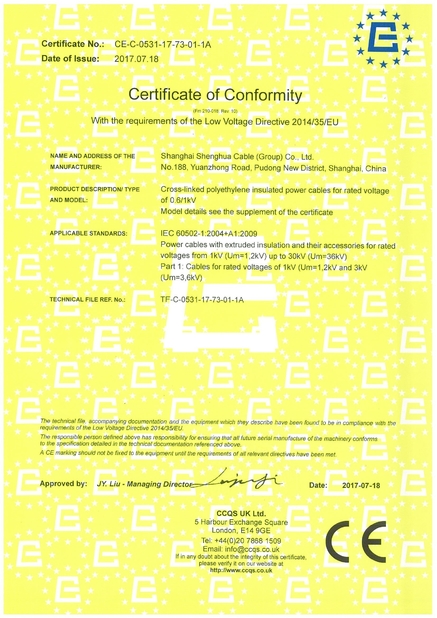
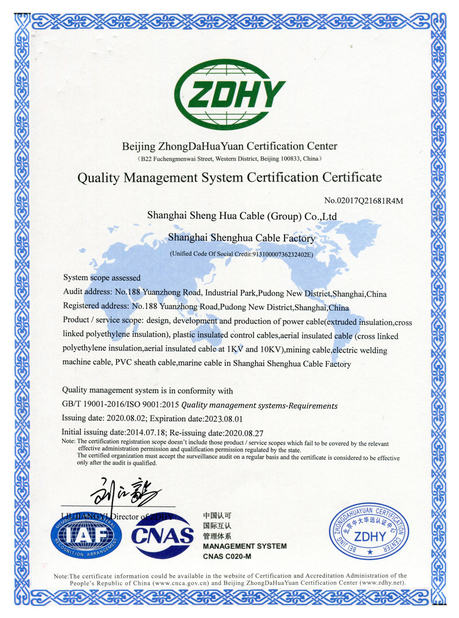
LSZH cable is a fire strategy decision expressed as a material specification. Specify the flame category, the smoke transmittance and both halogen tests by number, confirm the conductor temperature and the mechanical limits of the compound, and apply it where the risk model justifies the premium rather than everywhere. Used that way, LSZH delivers measurable life safety and equipment protection benefits at a controlled cost. Shanghai Shenghua Cable Group manufactures LSZH power, control and solar cable with XLPE or halogen free insulation, test reports to IEC 60332, IEC 61034-2 and IEC 60754, and jacket printing that matches the declared category. Send your fire strategy requirements, voltage class and installation route through our contact page and our engineers will return a compliant construction with the supporting type test documents.