A PVC control cable is not a small power cable, and specifying it as one is a common and expensive mistake. Control cable carries signals and switching commands: its current is small, its core count is high, its screening matters and its fault behaviour is different from a power cable's. This guide explains the KVV and KVVP families, the difference between control, signal and instrumentation cable, when screening is required and how to earth it, how to separate control circuits from power circuits in a tray, and how to size conductors for voltage drop rather than for current. It ends with six answers on core numbering, screening, armouring and the mistakes that cause intermittent faults in automation systems.

Control cable transmits commands, status signals and measurements between switchgear, drives, sensors and control panels. Its conductors are typically 0.5 to 10 mm2, its core count ranges from two to more than sixty, and its cores are numbered rather than colour coded beyond a small number. The rated voltage is usually 450/750 V, which is a design voltage for insulation co-ordination rather than an indication that the cable should carry power loads.
The common PVC families are straightforward. KVV is a PVC insulated, PVC sheathed control cable with numbered black cores and one green-yellow earth core. KVVP adds a copper wire braid or copper tape screen for electromagnetic compatibility. Flexible versions use finely stranded conductor for panel wiring and for connections to moving parts. Armoured versions, usually steel wire or steel tape, are used where mechanical protection is needed in trenches or buried ducts.
| Type | Screen | Armour | Typical use |
|---|---|---|---|
| KVV | None | None | Indoor control in tray or trench |
| KVVP | Copper braid or tape | None | VFD and signal circuits |
| KVV22 | None | Steel tape | Buried or ducted control |
| KVVP22 | Copper braid | Steel tape | Buried screened control |
| Flexible control | Optional | Optional | Panel wiring, moving parts |
Instrumentation and signal cable is a related but distinct family, usually with lower capacitance, tighter impedance control and better screening, and often with twisted pairs. Where a cable must carry an analogue measurement rather than a discrete command, the specification should say so, because a general purpose control cable may pass the test at commissioning and then pick up noise from a drive once the plant is running.
Control circuits fail in ways that power circuits do not: intermittently, and usually only when a particular machine is running. The causes are almost always specification or installation issues rather than manufacturing defects.
1. Treated as a small power cable. A designer who applies power cable logic chooses a size for current and ignores capacitance, screening and pair twisting. The cable carries the signal at commissioning and becomes unreliable when a variable speed drive is energised nearby, producing the intermittent faults that consume days of maintenance time.
2. Screening without earthing. A screened cable whose screen is left floating at both ends, or earthed at only one end when both ends are needed, provides little protection and can make interference worse by acting as an antenna. Screen termination is part of the cable system, not an afterthought.
3. Control and power in the same tray without separation. Long parallel runs of control cable next to motor cables couple noise into the control circuit. Physical separation, or a metal barrier, is the standard remedy and it must be designed, not left to the installer.
4. Voltage drop ignored. A 1.5 mm2 conductor carrying a 24 V signal over 300 m can lose a significant fraction of its voltage. Control circuits are frequently sized for current, which is tiny, and fail the voltage requirement, which is not. The result is a contactor that chatters or a sensor that reads low.
5. Wrong flexibility. Rigid control cable wired into a panel door that opens daily will break at the strands within months. Flexible cable with fine stranding is required for any part that moves, and that includes panel doors, machine heads and cable chains.
Start with the signal type. Discrete 24 V or 230 V commands need only basic insulation and a modest screen, if any. Analogue measurements, encoder signals and communication buses need twisted pairs, defined impedance and continuous screening. Where a variable frequency drive is involved, assume screening is required and specify a braided screen with a defined coverage, typically above 80 percent, plus a drain wire for termination.
Size for voltage drop, then check the current. For a 24 V DC circuit, allow no more than a few percent drop over the round trip, which means the conductor size grows quickly with distance. For 230 V AC control circuits the constraint is less severe but still real on long runs. State the maximum loop resistance in the specification, because it forces the factory and the designer to agree on the same number.
Decide the screening and earthing arrangement before the cable is ordered. For analogue signals, earth the screen at one end to avoid circulating currents. For high frequency interference from drives, bond the screen at both ends to the enclosure, using a proper gland or clamp rather than a pigtail. Document which end is earthed, because an installation where nobody knows is an installation that will be modified incorrectly later.
Separate the routes. Keep control cable at least 300 mm from power cable where they run parallel, or use a metal barrier, and cross power cables at right angles where crossing is unavoidable. Inside panels, route control wiring away from contactor and drive output cables, and use shielded enclosures where drives are installed. These are cheap measures during installation and expensive retrofits afterwards.
Finally, test for continuity and insulation resistance per core, and check the screen continuity from end to end. Record the results against the core numbers, not as a single figure, because the fault you are looking for is usually one core in a multi-core cable, and the record is what tells you where to look.
| Signal type | Cable requirement | Screen earthing |
|---|---|---|
| Discrete 24 V command | KVV, numbered cores | Optional |
| Analogue 4-20 mA | Twisted pair, screened | One end |
| Encoder or pulse | Screened, defined impedance | Both ends, 360 degree bond |
| VFD control | Braided screen above 80 percent | Both ends |
| Buried control | Armoured KVV22 | As required by design |
Representative products include the KVVP 4x1.5mm2 shielded flexible control cable 450/750 V, the KVV 7x1.5mm2 unshielded control cable for signal transmission, and the unarmoured PVC control cable for indoor cable trenches. Armoured routes use the steel wire armoured multicore PVC control cable, while automation panels commonly use the 1.5 mm2 multi-core unarmoured control cable or the flexible control wire with CE and KEMA certification. Heavy industrial circuits use the copper jacket control cable with class 2 connector, and fire related control circuits the mica tape fire resistant control cable for smoke control systems.
Control cable is ordered by core count and cross section, but the details inside that description decide whether the installation is maintainable. Cores should be numbered with durable print, and the numbers should correspond to the terminal schedule so that an electrician can identify a core at both ends without a bell set. One green-yellow earth core is standard, and its position in the lay should be consistent between deliveries, because a change of lay order between batches makes jointing a multi-core control cable a memory test rather than a procedure.
Order spare cores. A control cable is rarely replaced for a fault in a single core; it is replaced when a modification needs one more conductor and none is available. Ten to twenty percent spare capacity, or a small number of spare cores in each multi-core cable, is far cheaper than a re-pull. The same logic applies to panel wiring, where a few spare conductors in a multicore run to a door or a machine head save an entire re-wire when a sensor is added three years later.
Control circuits deserve their own commissioning routine, separate from the power tests. Measure insulation resistance per core to earth and between adjacent cores, check screen continuity from end to end, and verify conductor continuity against the terminal schedule core by core. For analogue loops, measure loop resistance and compare it with the transmitter's permitted load, because a loop that is electrically continuous can still fail to communicate if the resistance is too high.
Then test under realistic conditions. Run the drive, energise the contactors and operate the machine while monitoring the control signals. Interference problems appear at exactly this moment and rarely before, so a commissioning that only checks continuity will hand over a system that fails the first time production starts. Record the results, note which screens were earthed where, and keep the terminal schedule with the drawing set.
PVC control cable is the default for indoor control work, but the environment inside an industrial plant is not uniform. Areas with oil mist, coolant spray or hydraulic fluid require a sheath that resists swelling, because a standard PVC compound softens and loses mechanical strength in contact with hydrocarbons. Areas with welding spatter need a harder sheath or a protective conduit. Hot zones near furnaces and ovens need XLPE or a special high temperature compound. Cold stores need a compound that does not embrittle below minus fifteen degrees. In each case the cable type changes while the designation may not, which is why the environmental conditions must be written into the enquiry rather than assumed from the cable family.
The same applies to mechanical duty. A control cable fixed in a tray survives on standard construction; a control cable running to a moving machine head needs fine stranding and a sheath that tolerates flexing, and a control cable in a cable chain needs a rating for continuous movement and a defined bending radius. Buying one control cable type for the whole plant usually means over-specifying in the static areas and under-specifying in the moving ones, which is the most expensive combination available.
Control cable quotes are often compared on price per metre of the same core count, which hides the differences that matter: core numbering quality, screen coverage, sheath thickness and the presence of an earth core. Ask for the screen coverage percentage, the conductor stranding class and the sheath material grade alongside the price. On a project with several hundred cables, these details determine whether the system is maintainable in five years, and they explain most of the price spread between apparently identical offers. Where a supplier cannot state the screen coverage, the screen is likely a tape rather than a braid, which matters in a drive environment.
No, not in general. Control cable is designed for small currents and signal integrity, without the fault withstand or thermal capacity of a power cable, even when the insulation voltage looks similar.
KVV is unshielded; KVVP has a copper braid or tape screen for electromagnetic compatibility. The P suffix indicates the screen.
For analogue signals, usually one end to avoid circulating currents. For high frequency interference from drives, both ends with a 360 degree bond to the enclosure.
From two cores up to more than sixty, with numbered black cores and one green-yellow earth core. Above a certain count the cores are numbered only.
Almost always interference coupling from the motor or drive cable. Screening, separation and correct screen earthing are the remedies.
Only where mechanical protection is required, for example in buried ducts, trenches or areas with rodent risk. Indoor tray routes normally use unarmoured cable.
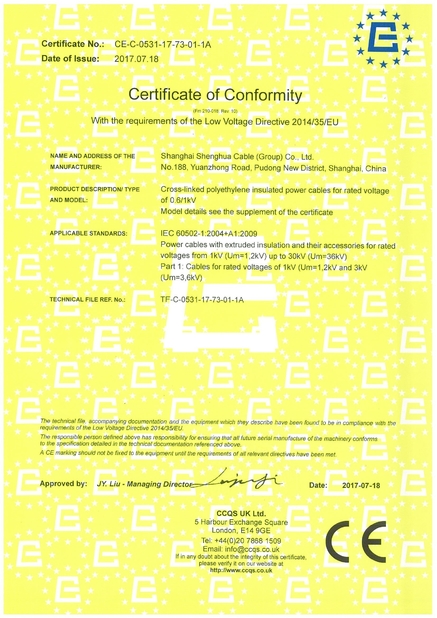
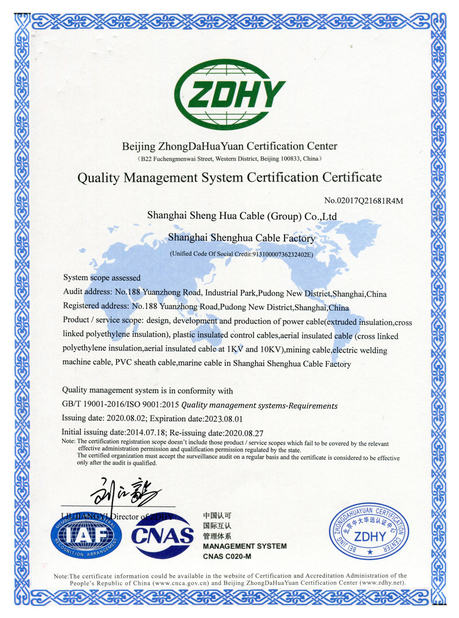
Control cable is a signal product, and it should be specified by signal requirements rather than by current. Choose the screen for the environment, earth it deliberately, separate it from power, size for voltage drop and match the flexibility to the movement it will see. Those five decisions remove the intermittent faults that cost more than any cable. Shanghai Shenghua Cable Group manufactures KVV, KVVP, armoured and flexible PVC control cable with numbered cores, braided screens and fire resistant options, from 0.5 to 10 mm2. Send your signal schedule, drive details and route plan through our contact page and our engineers will propose the cable types, screening arrangement and separation distances for your control system.